





The honest shortlist

Base44 alternatives with no lock-in

Base44’s lock-in is specific, and it helps to be precise about it. The frontend is standard code, and from the Builder plan it syncs to GitHub. The backend is the part that stays. The database, logins and backend logic run on Base44 and can only be reached through Base44. Data models are not included in the code on GitHub, and even Base44’s developer export tool creates a new, empty Base44 backend. Leaving means rebuilding everything behind the interface. These six alternatives avoid that.

WebTwizzLovableBolt.newv0 by VercelReplitCursor
Base44
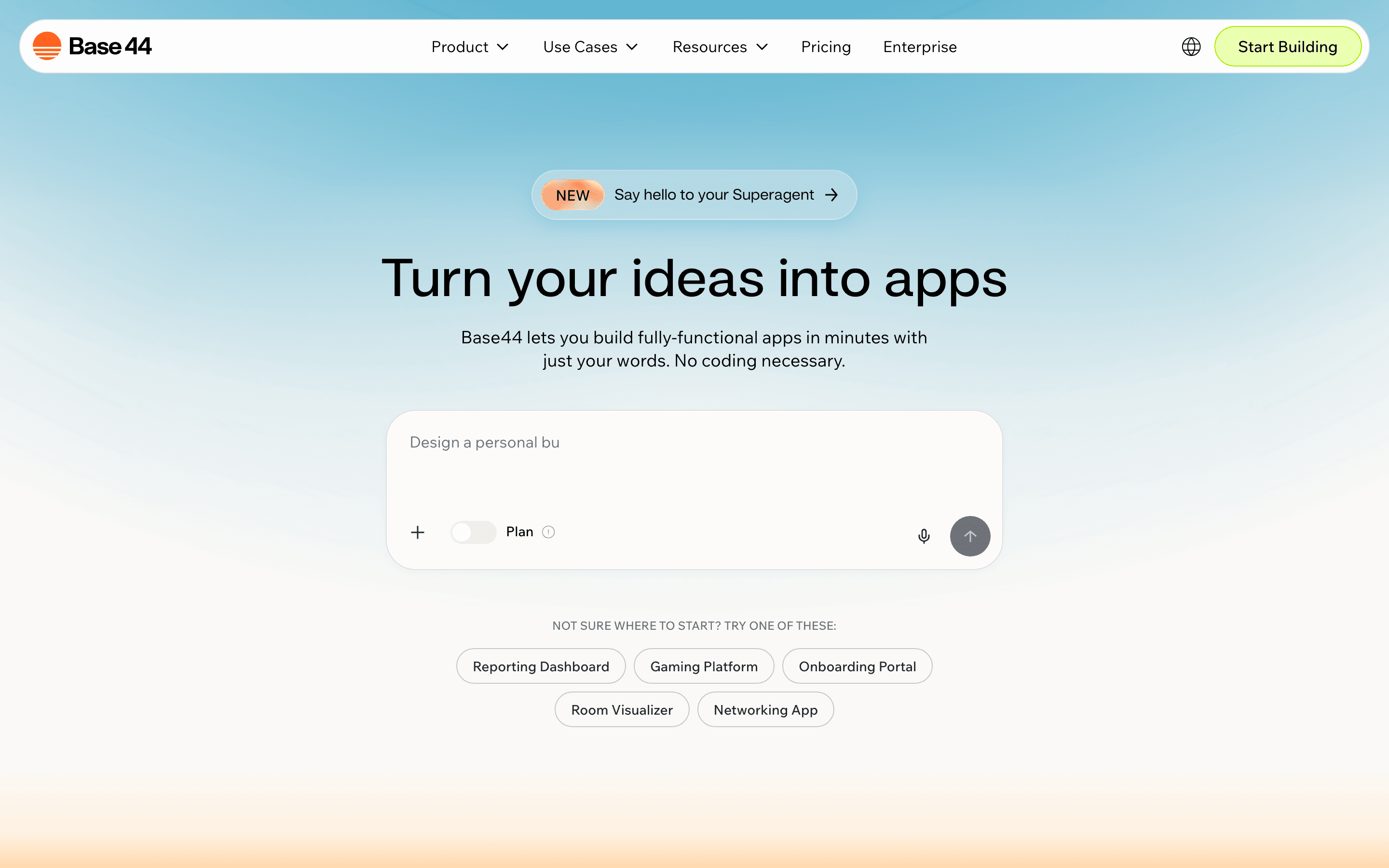
Base44 landing page

Base44 today. Here's what to use instead, and when.

01 / At a glance

6 Base44 alternatives, side by side.

Prices and features come from each tool's own pricing page and docs, checked September 20, 2026. Detailed breakdowns follow.

#ToolPricing
1WebTwizzOur pickFree, then from $25/mo
2LovableFree, then from $25/mo
3Bolt.newFree, then from $25/mo
4v0 by VercelFree, then $30/user/mo
5ReplitFree, then from $20/mo
6CursorFree, then from $20/mo

02 / The honest take

Why people look for a Base44 alternative.

  • The app depends on Base44’s hosted backend. Only the frontend is portable.
  • The database is Base44’s own, not a standard database like Postgres or MySQL that you can connect your own tools to.
  • Data models are managed inside Base44 and are not part of the code on GitHub.
  • GitHub sync needs the Builder plan, $40/mo billed annually, and only the main version of the code syncs back.
  • Payments run on Base44 Payments, powered by Wix, which has owned Base44 since June 2025.

None of this means Base44 is bad. It just isn't the right fit for everyone. Below are the alternatives worth your time.

03 / The shortlist

Each alternative, in detail.

What each tool is, how it compares with Base44, what it costs, and where it falls short.

1. WebTwizz: best for building a real web app from a prompt and still owning the code

Our pick · AI app builder with a visual editor

WebTwizz builds a full web app from a plain-language prompt: pages, logins, database and payments. You get the full code, in a normal format any developer can work with. You can change it three ways, by asking the AI, by selecting elements in a visual editor, or by editing the code, and all three change the same project.

WebTwizz compared with Base44

WebTwizz takes the opposite approach to the backend. It never holds it. Your database and logins live in your own Supabase project, or in a Postgres, MySQL or MongoDB database you connect, and payments go through your own Stripe account. You get the full code of your app, in a normal format any developer can work with, and it syncs both ways with GitHub. If you left WebTwizz, you would put that code on another host and change nothing in the backend. The trade-off is one extra step at the start, connecting Supabase, that Base44 does for you.

Strengths

  • +A real visual editor: select any element to change text, styles and layout without writing a prompt
  • +Your app’s code is yours, in a normal format any developer can work with, not a locked-in one
  • +Two-way GitHub sync, so you can keep working in Cursor or any other editor
  • +Hosting, custom domains and version history are part of the product
  • +Free credits every day on every plan, including paid ones

Limitations

  • –Web apps and websites only. It does not produce native iOS or Android apps
  • –Every app is built the same way. If you need a specific programming language or setup, a developer tool is a better fit
  • –The code editor, code export and custom domains need a paid plan
  • –A younger product with a smaller community than Lovable, Bolt or Replit
Pricing
Starter is free: 10 credits every day (up to 50 a month), a 100-credit signup bonus, and 1 published site. Standard is $25/mo for 1,500 credits or $40/mo for 3,000. Pro is $50, $70 or $100/mo for 4,500, 6,000 or 9,000 credits. Annual billing gives two months free.
Your code
You get the full code of every project. Paid plans include the code editor and a full code export. Two-way GitHub sync lets you work on the code in another editor and pull the changes back in.
Hosting
One-click publish to a webtwizz.app subdomain on every plan. Custom domains with SSL and private sites, where you invite people by email, are on paid plans.
Database, logins, payments
Connect Supabase for the database, logins and file storage, or bring your own Postgres, MySQL or MongoDB. Stripe, Resend, OpenAI, Anthropic, PostHog, Sentry and Google Sheets connect from the integrations panel. A built-in CMS covers simple content without a database.


2. Lovable: best for chat-first building with a backend included

Chat-to-app builder

Lovable builds a full-stack web app from chat: frontend, database, logins and integrations, hosted for you. The code is standard, with nothing proprietary. New projects since May 2026 arrive as fully built pages, which helps search engines read them. Older projects build their pages in the visitor’s browser instead.

Lovable compared with Base44

Lovable’s built-in backend is built on Supabase, and you can use your own Supabase project instead of Lovable Cloud, which puts the data in an account you control. Two-way sync with GitHub, GitLab or Bitbucket is on every plan, including Free, where Base44 asks for the $40 Builder plan. It is the easiest move for someone who likes how Base44 works.

Strengths

  • +Two-way code sync is on the free plan, across GitHub, GitLab and Bitbucket
  • +Priced per workspace with unlimited members on every plan
  • +New projects arrive as fully built pages, which helps search engines read them
  • +A broad built-in backend: database, logins, storage, backend logic and payments

Limitations

  • –Restyling a selected element goes through a prompt and costs credits. There is no manual style panel
  • –Web apps only. Lovable does not build native phone apps
  • –The free plan cannot edit code, download the code or use a custom domain
  • –Running out of credits pauses building and the backend services of deployed apps

What users say

  • Users report credits running out quickly, often on the AI retrying its own failed fixes on larger apps.
  • Users report unused paid credits becoming unavailable after cancelling or downgrading.
Pricing
Free gives 5 build credits a day, capped at 30 a month. Pro starts at $25/mo for 100 credits ($21/mo billed annually) and scales up in credit tiers. Business starts at $50/mo. Plans are priced per workspace, not per seat, and credits roll over on paid plans.
Your code
Two-way sync with GitHub, GitLab or Bitbucket on every plan, including Free. Editing code in the product and downloading the code need a paid plan. You cannot bring in existing code. Lovable always creates a new code project.
Hosting
Publishes to a lovable.app address on every plan. Custom domains need Pro or higher. Heavy backend or hosting usage draws on a separate pool of Cloud credits.
Database, logins, payments
Lovable Cloud includes a database, logins, file storage, backend logic and scheduled jobs, built on Supabase. You can bring your own Supabase project instead. Payments run through Stripe or Paddle on Pro and up.

3. Bolt.new: best for more choice in how the app is built, and a route to mobile apps

AI builder that runs in your browser

Bolt is an AI builder for websites, web apps and mobile apps, made by StackBlitz. It runs a full coding workspace in your browser, generates code from chat, and bundles hosting, domains and a database as Bolt Cloud. Backends are limited to one programming language.

Bolt.new compared with Base44

Bolt produces standard code that you can download as a zip or sync with GitHub, with no plan gate documented for either. Its database can be claimed into your own Supabase account. It also offers a real route to native phone apps, where Base44 wraps the web app.

Strengths

  • +Supports several coding setups instead of one fixed way of building
  • +A documented path to native phone apps
  • +Visual edits and manual code edits cost no tokens until you save
  • +Zip download and two-way GitHub sync, including bringing in existing code from GitHub

Limitations

  • –Backends are limited to one programming language
  • –A web project cannot easily become a mobile one later. Mobile has to be chosen in the first prompt
  • –Free hosting goes offline once the monthly cap is hit
  • –Token use climbs as the project grows

What users say

  • Users report tokens being spent on the AI fixing errors it introduced.
  • Users report slow customer support, including on paid plans.
Pricing
Free includes 1M tokens a month with a 300K daily cap. Pro starts at $25/mo for 10M tokens ($18/mo billed annually) with higher token tiers above it. Teams is $30 per member per month. Token use grows with project size because Bolt re-reads project files on each message.
Your code
The code view lets you edit files directly, and manual edits cost no tokens. You can download the project as a zip, sync both ways with GitHub, and bring in existing code from GitHub.
Hosting
Publishes to a bolt.host address. The free plan has a hard cap of 10 GB bandwidth and about 333,000 requests a month, and the site goes offline when it is exceeded. Custom domains need a paid plan. Netlify is an alternative deploy target.
Database, logins, payments
Bolt Cloud creates a database with logins, file storage and backend logic when the app needs one. Supabase works as an alternative, and Stripe handles payments.

4. v0 by Vercel: best for teams already building on Vercel

AI app builder from Vercel

v0 is Vercel's AI app builder. It used to generate individual interface pieces only. Since a February 2026 update it builds full-stack apps, with a code editor, a developer-style review workflow on GitHub, and previews that run the real app. It deploys to Vercel.

v0 by Vercel compared with Base44

v0 has no backend of its own to lock you into. Databases and logins come from services you connect, such as Supabase or Neon, and the code is standard code on GitHub, where each change is reviewed before it goes live. Hosting is on Vercel and can be moved.

Strengths

  • +A detailed visual editor on the free plan: typography, spacing, borders, shadows and more
  • +A developer-style workflow on GitHub where each change can be reviewed and previewed before it goes live
  • +Output is standard code in a common, widely used setup
  • +Per-model token rates are published on the pricing page

Limitations

  • –No built-in database or logins. You connect and manage those services yourself
  • –It is built around one way of building apps. Other setups are possible but less reliable, per the docs
  • –Hosting means a Vercel account, with Vercel’s own pricing on top
  • –The free plan stops at 7 messages a day

What users say

  • Users report monthly credits running out within days since the move to usage-based pricing.
  • Users report the agent looping and spending credits on its own mistakes.
Pricing
Free includes $5 of monthly credits and 7 messages a day. Plus is $30 per user per month with $30 of credits and $2 of free credits each day you log in. Business is $100 per user per month. Credits are spent per token at each model’s rate, and chat history counts as input.
Your code
A built-in code editor with search and a view of what changed. GitHub sync is on the free plan: each chat works on its own copy of the code, and v0 saves each change to GitHub and proposes it for review. You can bring in existing code from GitHub.
Hosting
One-click deploy to Vercel with a vercel.app address, plus a separate live preview for each chat’s copy of the code. Custom domains are set up in the Vercel dashboard.
Database, logins, payments
No database or logins of its own. The backend is code inside the app itself, plus Vercel Marketplace integrations such as Supabase, Neon, Upstash and Stripe.

5. Replit: best for building and hosting in one place, in any programming language

Online coding workspace with an AI agent

Replit is a browser-based coding platform. Its AI Agent builds apps from prompts, and the same product includes a code editor, a visual editor, a database, file storage, logins and hosting. It also builds mobile apps, with a documented App Store submission flow.

Replit compared with Base44

Replit keeps Base44’s everything-in-one-place convenience and uses standard parts: code with full version history that syncs with GitHub, and a standard database you can move. That makes it the closest no-lock-in equivalent to Base44’s all-inclusive model, with usage-based billing as the cost.

Strengths

  • +Editor, agent, database, logins, storage and hosting under one account
  • +A click-to-edit visual editor where simple edits use no AI credits
  • +Developer-style version control that syncs with GitHub both ways
  • +Builds more than web apps, including mobile apps, in any programming language

Limitations

  • –Usage-based billing. Building, hosting and the database all draw from the same credits
  • –On the free plan, the published app link goes down after 30 days
  • –Apps and databases go idle when unused, so the next visit starts slowly
  • –It is a full coding workspace, which is more to learn than a focused builder

What users say

  • Users report bills well above what they expected as credits drained.
  • Users report the Agent fixing one thing and breaking another, with each repair costing more credits.
Pricing
Starter is free, with one published app whose link goes down after 30 days. Core is $20/mo ($18/mo billed annually) and Pro is $100/mo ($90/mo billed annually). Plans come as monthly credits, and Agent work, hosting, database and storage all draw from the same credits, with pay-as-you-go above that.
Your code
Code lives in a Replit workspace with full developer-style version control. You can bring in code from GitHub and send changes back to it.
Hosting
Built-in hosting on a replit.app address, with several deployment types. Custom domains are supported. Hosting is billed by usage from your credits, and autoscale apps go idle after 15 minutes of inactivity.
Database, logins, payments
Built in: a managed database, file storage and two login options (Replit Auth, or Clerk under your own brand). Connectors for Stripe and other services need the Core plan.

6. Cursor: best for developers working on code they already have

AI code editor

Cursor is an AI code editor and coding agent: a desktop editor, a command-line tool and cloud agents that work on your code and propose changes for review. It edits code in any programming language. It does not host your app or give you a database.

Cursor compared with Base44

If you have a developer, Cursor removes the platform entirely. A Base44 frontend taken out through GitHub can be opened in Cursor and rebuilt against a backend you choose. It needs coding skills.

Strengths

  • +Works on any existing code in any programming language, with nothing locked to a platform
  • +A wide choice of models at published per-token rates
  • +Cloud agents run in parallel, test their work and propose changes for review
  • +Design Mode lets you click an element in the running app to direct a change

Limitations

  • –You need to be able to code. It assumes you can run a project, review changes and manage code versions yourself
  • –No hosting, database or logins. You assemble and pay for those separately
  • –Design Mode is a way to prompt the agent, not a style panel. Every change uses a model
  • –Included usage can run out well before the month ends under heavy agent use

What users say

  • Users report the $20 plan’s included usage running out within days of heavy agent use.
  • Users report being blocked from even small tasks once both usage pools are spent.
Pricing
Hobby is free with limited agent requests. Pro is $20/mo, Pro Plus is $60/mo and Ultra is $200/mo, each with more included usage. Teams starts at $40 per seat. Usage is billed by tokens from monthly pools, and once they run out you pay on demand or wait for the next cycle.
Your code
The code is already yours. Cursor edits files on your machine, and cloud agents work on a separate copy of your code on GitHub, GitLab or Bitbucket. There is nothing to export.
Hosting
None. You deploy the app yourself, wherever you choose.
Database, logins, payments
None built in. Cursor writes code against whatever database and login service you set up.

04 / The short answer

Which Base44 alternative should you pick?

You want the data in your own database from the start

WebTwizz. It connects to your Supabase project or your own Postgres, MySQL or MongoDB.

You want the feel of Base44 with a portable backend

Lovable. Chat-to-app, with Supabase underneath and GitHub sync on the free plan.

You want everything included, on standard parts

Replit. Standard version history and a standard database, with hosting built in.

You also need a native mobile app

Bolt.new. A documented path to native phone apps.

You have a developer and want no platform

Cursor. Rebuild the backend on your own terms.

How we put this list together

Everything on this page about pricing, plans, code access, hosting and built-in features comes from each tool's own pricing page, documentation and changelog, last checked September 20, 2026. Every tool section links to the pages we used. The "what users say" notes summarise recurring threads on public forums, and they are opinions, not measurements.

This is a comparison of what each product offers, not a benchmark. We didn't score output quality, because that changes with every model release and depends heavily on what you're building. WebTwizz is our product, so it's listed first. The rest are ordered by how close a fit they are for someone moving off Base44. These tools change their plans often, so check the linked pricing pages before you commit.

Questions, answered.

What people ask before switching off Base44. Anything else, our team is one email away.

Because GitHub sync covers the frontend. Base44’s docs describe the backend, meaning the database, logins and backend logic, as managed by Base44 and reachable only through Base44. Data models are not in the code on GitHub, and Base44’s developer export tool creates a new, empty Base44 backend. The code that leaves still needs Base44 to run.

The app is standard code in your GitHub account, and the backend runs on accounts you own. WebTwizz’s hosting, visual editor and AI are what you would stop using if you left. The app and its data would carry on elsewhere. The code editor and export are paid features, which is worth knowing before you start.

Nobody outside Wix knows. What is on record: Wix said at the acquisition in June 2025 that Base44 would keep operating as a distinct product, and Base44’s docs now include payments powered by Wix and buying domains through Wix. If that direction worries you, a portable backend is the practical protection.

The interface is the quick part. Most builders can recreate it from a description, and the frontend code can be reused by a developer. The work is in the data: exporting it from Base44, designing tables in the new database and importing it. Plan for that before you switch.

Base44 bundles email sending, automations, in-app AI agents and payments with no other accounts. On a portable setup you connect equivalents such as Resend for email and Stripe for payments. That is a few more accounts, in exchange for being able to replace any one of them.

Your idea, live in minutes.

Describe what you want. WebTwizz builds the real thing, then you click to change anything. No code needed.

Get started for free, no credit card needed.