You've built the landing page, added a sign-up form, and persuaded a handful of providers to create profiles. Then you refresh the dashboard and see the problem: no buyers, no bookings, and no reason for either side to return. A double sided marketplace doesn't fail because the interface is ugly. It fails because the product never creates a reliable exchange between two groups.
You can build the first working version without hiring a developer, but you have to design the marketplace as an operating system for matches, trust, and money. An AI app builder can handle much of the structure. It can't decide which side to seed, rescue weak liquidity, or invent a credible dispute policy for you.
What a Double Sided Marketplace Actually Is
The empty listings page tells you more than a full analytics dashboard. It shows whether your product creates value when one person arrives alone. In a single-sided SaaS product, one user can often sign in, enter data, and get utility immediately. In a double sided marketplace, a provider can publish a service and still receive nothing useful until a requester appears with the right need, timing, and willingness to pay.
That makes the product more than a directory. A directory stores profiles. A marketplace creates the conditions for matching, coordination, payment, and repeat transactions between distinct groups. The platform usually earns a transaction or facilitation fee, so its revenue depends on successful exchanges rather than registration volume.
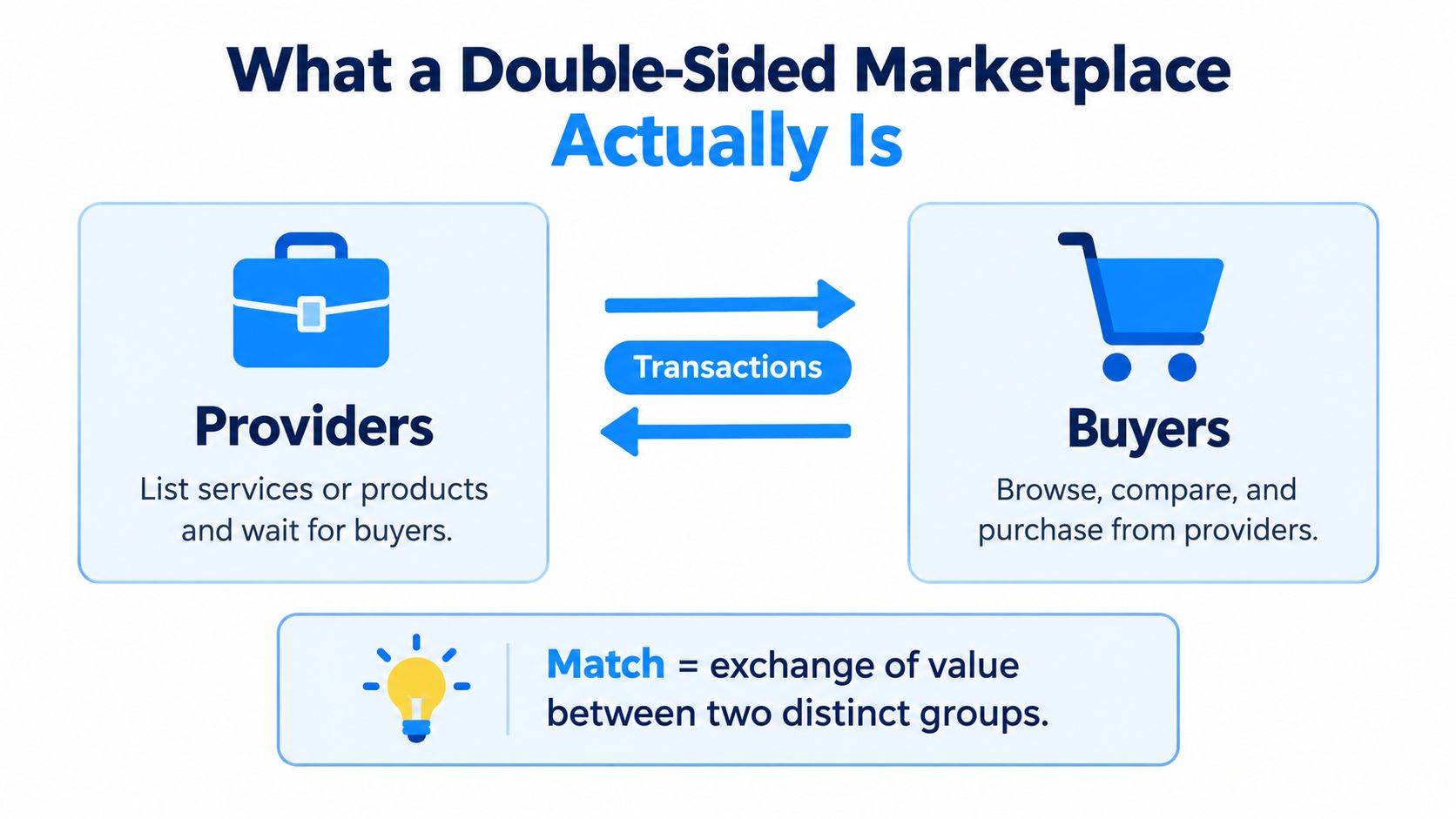
The product has two customers
Consider a local home-repair marketplace. Providers need useful requests, clear job details, and dependable payouts. Buyers need relevant providers, visible availability, credible reviews, and protection if the work goes wrong. A feature that improves one side while frustrating the other can reduce total transaction volume.
This interdependence is the defining economic feature. Platform economics describes a system where two groups interact through an intermediary, and where growth on one side increases value for the other through indirect network effects. The model predates modern apps. Business educators trace it back at least to the 1830s penny press, where newspapers sold access to readers and advertiser attention, making the publication a meeting point for two paying sides (GetSmarter's explanation of two-sided markets).
For a founder, the practical test is simple:
- Supply question: Does this feature help providers list, respond, deliver, or get paid?
- Demand question: Does it help buyers discover, compare, book, or trust?
- Balance question: Which side is currently blocking a transaction?
If you already have providers, another provider dashboard may not be the priority. Better search, narrower location filters, or a buyer request flow may create more value. If buyers are waiting but providers respond slowly, onboarding, availability controls, and response notifications matter more than adding another marketplace category.
Practical rule: Evaluate every feature against one question: does it bring in the missing side, or convert the side already using the product?
A usable marketplace MVP therefore needs two role-aware experiences, not one generic account area. It needs a provider workflow that produces structured supply and a requester workflow that turns intent into a transaction. If either workflow ends at “submit,” you've built a directory with extra steps.
The Economics That Drive Two-Side Growth
A tutoring marketplace charges a learner $40, pays the tutor $30, and keeps the remaining amount before payment costs and operating expenses. The founder is considering reducing the tutor payout to $25 to finance discounts for learners. That decision isn't solved by asking which side complains more. It depends on cross-side elasticity, meaning how strongly participation on one side responds to changes affecting the other side.
If the lower learner price brings substantially more qualified bookings, tutors might earn more overall despite the lower payout per lesson. If tutors leave because the payout no longer compensates them, learners see fewer suitable matches and the discount loses its purpose. The same fee change can produce opposite results in different categories.
Think in loops, not isolated prices
A double sided marketplace grows through a loop:
- More relevant tutors improve availability and match quality.
- Better match quality improves learner conversion.
- More learner demand gives tutors a reason to join and remain active.
- Greater tutor participation improves the buyer experience again.
That loop is a cross-side network effect. It doesn't mean every new user helps automatically. A tutor in the wrong location, category, or time window may add profile count without adding liquidity.
Pricing should therefore reflect side-specific elasticity. One side may be highly sensitive to price, while the other is more sensitive to income certainty, lead quality, or time spent waiting for a booking. A platform can subsidize the side that initiates transactions, but it needs a measurement hook that shows whether the subsidy creates completed matches rather than inexpensive sign-ups.
| Lever | Side Affected | Effect on Demand | Best Used When |
|---|---|---|---|
| Buyer discount | Buyers | Lowers the cost of trying the marketplace | Providers are ready, but requesters hesitate at checkout |
| Provider bonus | Providers | Increases listing or response activity | Buyers search successfully but can't find available supply |
| Lower take rate | Providers | Improves provider earnings per transaction | Provider acquisition or retention is the main constraint |
| Featured placement | Providers | Concentrates visibility on selected supply | Buyers face too many weak or incomplete listings |
| Minimum booking fee | Buyers and providers | Protects transaction economics | Small transactions create disproportionate support or payment work |
Don't confuse this work with general promotion. A practical 4Ps marketing guide from Wispra can help organize the broader offer, price, distribution, and promotion decisions, but your marketplace still needs side-specific evidence from searches, responses, bookings, and cancellations.
Start with a narrow transaction and record what happens at each step. If buyers search but don't request, the issue may be trust or relevance. If providers accept but buyers don't confirm, the issue may be payment protection or unclear expectations. The take rate is only one variable in a coupled system. Acquisition cost, incentives, fulfillment quality, and repeat usage move together.
Core Mechanics Every Marketplace Needs
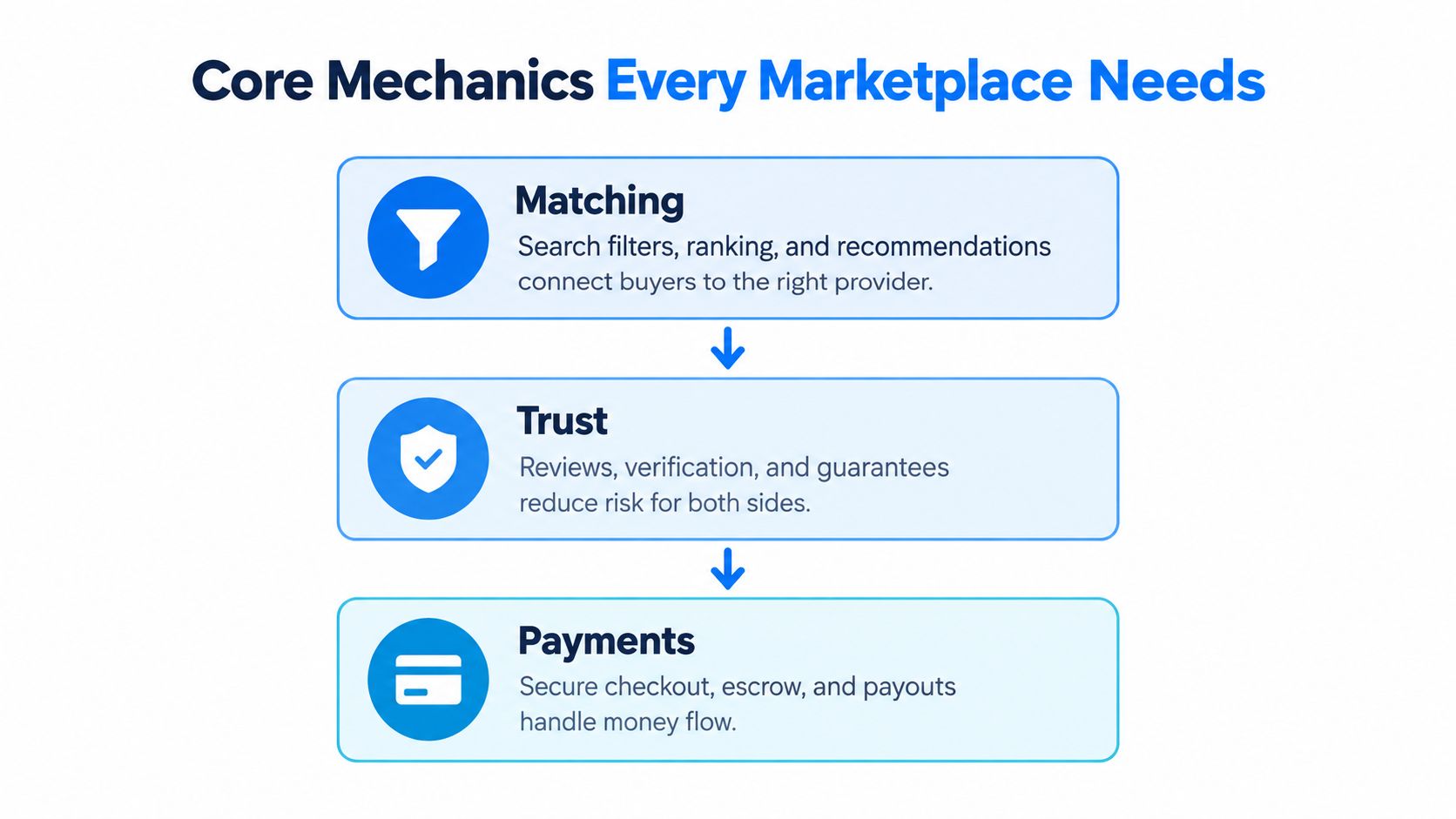
A marketplace can have attractive profiles and still fail at the transaction layer. Three systems carry nearly all of the commercial weight: matching, trust, and payments. They should appear in your MVP plan as connected workflows, not as a list of optional features.
Matching turns inventory into liquidity
Matching decides whether a buyer can find a suitable provider without excessive effort. At the basic level, this means structured categories, location, price, availability, and search filters. Ranking determines which supply appears first. Recommendations and curated introductions become useful when a self-serve search produces too many irrelevant options.
Weak matching creates a deceptive problem. Your database may contain plenty of listings, but buyers still experience an empty marketplace if the results don't fit their need. Providers then see poor conversion and stop maintaining availability. Useful health signals include time to first match, fill rate, search-to-request behavior, and churn on each side. The economic value comes from completed matches, not raw sign-ups.
Trust reduces perceived transaction risk
Trust sits between discovery and payment. Buyers want evidence that a provider is legitimate and capable. Providers want confidence that buyers will provide accurate information and pay. Profiles, reviews, identity checks, clear policies, messaging, deposits, and dispute handling all reduce uncertainty.
A review system without moderation can damage trust instead of creating it. A verification badge with no explanation can confuse users. A guarantee that you can't operationally honor can create a larger liability than having no guarantee. Start with the smallest policy you can enforce consistently, then log every dispute so you can see which rules need refinement.
Payments settle the promise
Payments answer practical questions that users notice immediately. Who pays whom? When is the provider paid? When does the platform deduct its fee? What happens after a cancellation, refund, or chargeback? Marketplace payment flows commonly use either direct split payments or collect-then-distribute models, and that choice determines whether funds sit with the platform and how payouts are scheduled (Nipige's marketplace payment overview).
Without a clean payment flow, users may arrange the transaction in chat and settle elsewhere. That creates leakage, weakens your fee model, and removes useful evidence when a dispute occurs. Your first build should make the intended transaction easier than an improvised workaround.
For a concrete starting point, a freelancer marketplace build flow can help you map providers, client requests, booking records, reviews, and moderation into one working product rather than disconnected screens. Broader growth tactics for B2B platforms are also useful when the two sides are businesses, but the same principle applies: acquisition only matters when the platform helps both sides complete valuable interactions.
Where Marketplace Products Quietly Fail
“Launch fast and iterate” works well for many single-user products. It becomes dangerous when founders treat a working interface as proof that a marketplace works. The silent failures usually appear after the first sign-ups, when users discover that the platform doesn't protect the value of staying active.
Liquidity decays by context
A founder launches nationally with providers in many categories. Buyers search in one city for one service and see thin or irrelevant results. The platform technically has supply, but the supply isn't available in the same context. As users spread across locations, categories, and time windows, transaction density falls.
The fix is concentration, not another batch of generic listings. Narrow the geography, category, or use case until a requester has a credible chance of finding a suitable provider. Track availability and completed matches by context, because overall user counts can hide an empty pocket.
Leakage removes your economic engine
A buyer finds a provider, exchanges contact details, and books future work directly to avoid the fee. The platform generated the match but loses the repeat transaction. This is especially painful when the platform contributes little after the introduction.
Anti-leakage mechanics need to give both sides a reason to keep using the product:
- Escrow or payment protection: Keep the platform useful when completion or quality is uncertain.
- In-product scheduling: Preserve calendars, reminders, rescheduling, and receipts.
- Reputation carryover: Let reliable behavior accumulate in a profile users don't want to abandon.
- Repeat-buyer routing: Make the next booking faster inside the platform than starting privately.
- Minimum activity thresholds: Reward providers who maintain availability and respond consistently.
These controls don't rescue a marketplace with no liquidity. They become effective after users already receive dependable value and understand the platform's protections.
Trust erosion and unit economics compound
One unresolved dispute can make a buyer avoid the category. A provider who repeatedly encounters vague requests may stop responding. Meanwhile, a free tier can attract users who consume support and matching resources without creating enough paid activity to cover the work.
The important diagnostic distinction is between product failure and liquidity failure. Silence after launch may mean the workflow is broken, or it may mean the right counterpart isn't present. Before rebuilding the interface, manually inspect searches, response times, failed bookings, and cancellations. An AI builder can wire thresholds, status changes, ratings, and payment events, but you still need to decide which behavior signals a healthy marketplace.
Building the MVP With an AI App Builder
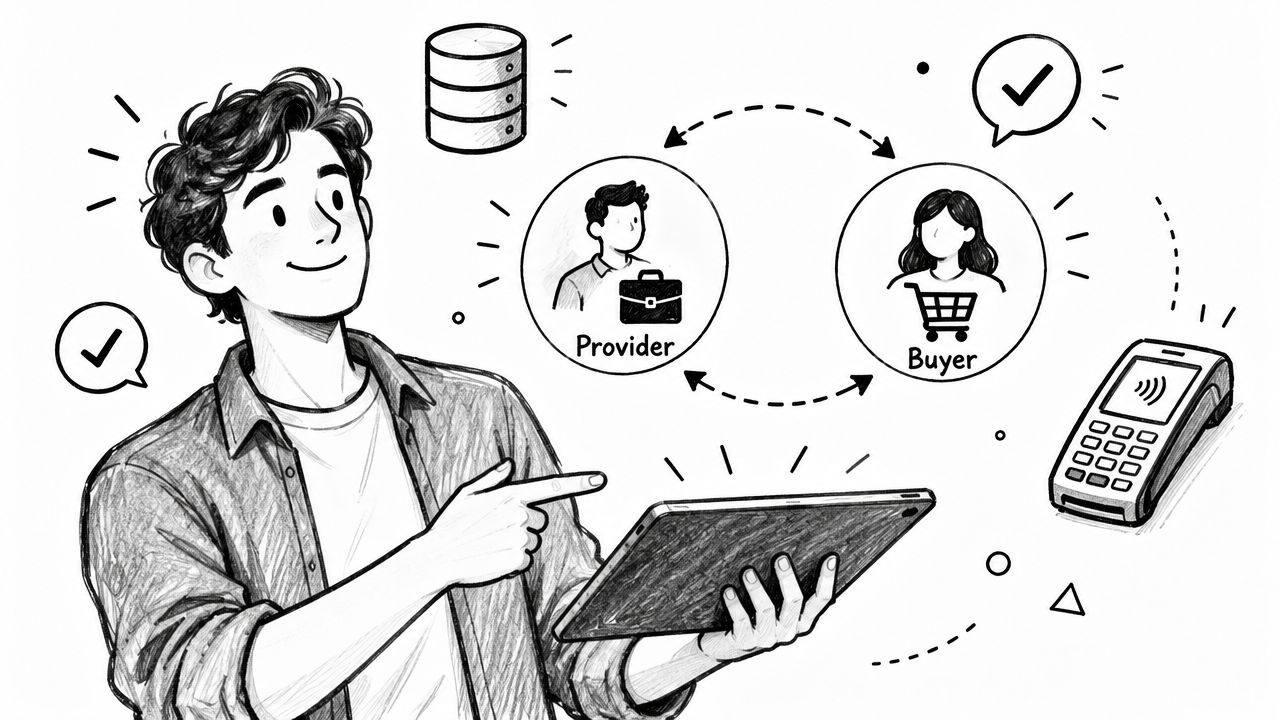
Start with the data model, not the homepage. A non-technical founder can give an AI app builder a precise sequence of prompts and review the result after each one. That approach works better than asking for “a complete marketplace” and accepting whatever screens appear.
Prompt the foundation in small passes
Use a sequence like this:
- Create the core entities. Ask for two user roles, provider and requester. Add provider profiles, listings tied to a provider, availability fields, and a booking or transaction record linking requester, provider, listing, price, status, and timestamps.
- Add role-aware authentication. Request one sign-in flow that routes providers to a provider dashboard and requesters to a buyer dashboard. Prevent users from accessing actions that don't belong to their role.
- Build supply creation. Give providers forms for title, description, category, price, location, availability, and image upload. Add draft, pending review, and published states so moderation isn't an afterthought.
- Build discovery. Give requesters a searchable listing view with category, location, price, and availability filters. Add a detail page with the provider profile, reviews, booking action, and clear cancellation terms.
- Build the transaction lifecycle. Use explicit statuses such as requested, accepted, declined, confirmed, completed, cancelled, and disputed. Add notifications or visible dashboard prompts for each status change.
- Add mutual ratings. Allow both parties to review after completion, and prevent reviews before a completed transaction. Store the booking relationship so reputation can't be created from random accounts.
A builder such as Webtwizz is relevant when you need to describe these workflows in plain language, publish a working web app, and retain ownership of the resulting source rather than stopping at a mockup. For a broader look at the category, this guide to an AI-powered no-code app builder covers the kind of product-building workflow non-technical founders typically evaluate.
Basic authentication, CRUD operations, role-based routing, forms, dashboards, and straightforward search are realistic early targets. Advanced matching is different. A builder can filter by structured fields, but complex ranking may require custom rules, better data, and ongoing evaluation.
Defer complexity without hiding it
Don't promise automated fraud scoring, dynamic pricing, complex dispute arbitration, or multi-region compliance in the first prompt. Create the data fields and admin states now, then handle the decision logic manually until you understand the edge cases.
A practical build sequence is:
- Structure session: Create roles, entities, dashboards, listing flow, and booking states.
- Transaction session: Add checkout, platform fees, payout logic, review eligibility, and basic notifications.
- Polish session: Test empty states, failed payments, cancellations, mobile behavior, moderation, and account permissions.
Use the first session to create a usable private link, not a polished public brand. Use real provider profiles and one narrow buyer journey. A focused weekend can produce a testable MVP, while the harder work remains learning whether the two sides complete transactions.
The video below provides a visual reference for how an AI-assisted app-building workflow can turn a plain-language product idea into a working interface.
Choosing a Payment Flow That Matches the Model
Payment architecture changes the responsibilities of the platform. Direct split payments route the buyer's payment to the provider while the platform takes its fee. Collect-then-distribute sends the payment through the platform first, then releases the provider's share according to completion, confirmation, or another rule.
A direct split flow suits transactions where the provider can be paid promptly and the platform doesn't need to hold funds. Collect-then-distribute offers more control for work that needs inspection, delivery confirmation, cancellation handling, or dispute review. The second model also creates more operational and compliance obligations.
Compare the two architectures
| Dimension | Direct Split Payments | Collect-then-Distribute |
|---|---|---|
| Money movement | Payment is divided between platform and provider | Platform collects, then sends the provider's share |
| Payout timing | Often immediate or based on processor settings | Scheduled or released after a defined event |
| Product complexity | Lower for a first MVP | Higher because release, refund, and dispute states need logic |
| Suitable use | Fast services, rentals, and lower-friction bookings | Freelance work, higher-value exchanges, or delivery-based transactions |
| Main risk | Less control after the payment is split | More responsibility for fund handling and payout decisions |
Suppose a buyer pays 100 and the platform takes a 15 percent fee. Under a direct split, the platform allocates 15 to itself and 85 to the provider, subject to processor fees and applicable adjustments. Under collect-then-distribute, the platform first receives 100, then releases 85 to the provider after the chosen condition is met. The illustration is simple, but the operational difference is substantial.
An AI builder will usually handle a basic payment integration and direct payout primitives more readily than a custom escrow-like workflow. You may need manual scheduling logic or a payment service designed for marketplace operations before you can safely automate conditional releases. This payment processing integration guide is a useful implementation reference when you're translating the payment decision into app requirements.
Payment rule: Choose the flow you can explain to a buyer, provider, accountant, and support operator without hand-waving.
Whichever model you choose, plan for identity checks, KYC, tax reporting, refunds, chargebacks, and regional rules. Payment processing isn't just a checkout button. It determines who carries risk when a transaction goes wrong.
Your Launch Checklist and the Next Move
Treat launch readiness as a series of pass-or-fail conditions. If an item isn't verifiable in the product, it isn't ready.
Marketplace launch punch list
- Supply is real: At least one narrow category has genuine provider listings, complete descriptions, current availability, and an owner responsible for keeping them accurate.
- Demand has a clear action: A requester can search, compare, submit a request, and understand what happens next without contacting you for instructions.
- Matching is bounded: Filters or curation keep results relevant to one defined location, category, audience, or timing constraint.
- Trust is visible: Every published listing shows the signals you can defend, such as provider information, reviews from completed transactions, verification status, or an explicit policy.
- Payment works end to end: A test buyer can pay, the platform fee is recorded, the provider payout follows the chosen flow, and cancellation behavior is documented.
- Statuses are explicit: Both sides can see whether a request is pending, accepted, declined, completed, cancelled, or disputed.
- Reviews are earned: The rating action appears only when the transaction reaches the state that qualifies for feedback.
- Leakage has a response: Your product offers a reason to keep booking, messaging, scheduling, paying, and building reputation on-platform.
- Measurement fires: You can identify the first search, first request, first acceptance, first payment, first completion, and first repeat transaction.
- Ownership is settled: You know where the app's source, data, credentials, and payment accounts live before inviting real users.
Don't start with a broad marketplace category. Choose the narrowest viable niche where the same type of buyer and provider can meet under a specific condition. Today, write the matching rule in plain language, feed it to your AI app builder, create the two roles and one transaction path, then send a private link to a small group for observed tests. Watch where users stop, and change the workflow before adding more features.
Webtwizz lets non-technical founders describe a working marketplace in plain language, build provider and requester workflows, connect listings to bookings, and publish the app to a real domain. Visit Webtwizz today, define your narrowest marketplace niche, and start the first two-sided flow without hiring a developer.
Last updated: September 24, 2026